
The Experiment: A 100% AI-Written Blog, Zero Ad Spend
About twelve months ago, I started a quiet experiment. I built a niche blog from scratch — no human-written content, no paid links, no social media push. Every single page was generated using AI, informed by keyword research and search intent, and then left to see what Google would do with it.
The results aren’t viral-worthy. But they’re real, they’re growing, and they tell a story worth documenting — especially for anyone wondering whether AI content can actually rank in 2025 and beyond.
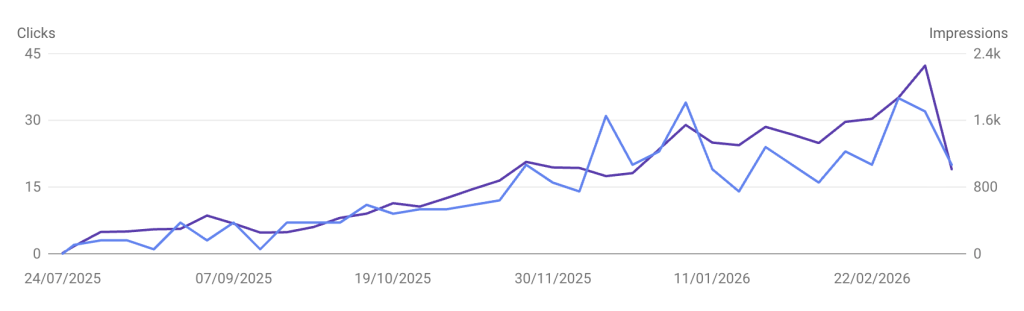
Where It Started: Zero
In July 2025, the site had zero impressions. Zero clicks. Google hadn’t acknowledged it existed. That’s not unusual for a new site — but it’s worth stating clearly: this wasn’t a site with existing authority that I pivoted to AI content. It was built from the ground up, in a niche, targeting the US market.
Over the following months, I published roughly 30 pages using AI. Not dumped in bulk — built out gradually, with each page targeting a specific topic cluster and search intent. The content was generated using AI tools, then reviewed, lightly edited for accuracy, and published.
The Strategy: GSC as a Feedback Loop
The part that made this work — and this is the part I want to emphasise — wasn’t just publishing AI content and hoping for the best. The real engine was using Google Search Console as a continuous feedback loop.
Every few weeks, I’d log into GSC and look at:
- Which queries were triggering impressions — often different from what I’d originally targeted
- Where pages were ranking — positions 8–20 are the sweet spot for optimisation effort
- Which pages had impressions but low CTR — a signal that the title tag or meta description needed work
I’d then go back into those pages, update the content to better match the actual search queries driving impressions, tighten the on-page signals, and republish. Rinse and repeat.
This is essentially AI SEO in practice — using data to inform AI-assisted content decisions rather than guessing at what to write.
Where It Is Now: 500 Impressions a Day
As of today, the site is generating approximately 500 impressions per day and around 10 clicks per day. That’s a growth curve from absolute zero, with no link building spend and no paid traffic.
Is 10 clicks a day going to make anyone rich? No. But consider what it represents:
- A 2% average CTR, which is in line with organic benchmarks for sites without strong brand recognition
- A growing impression curve that suggests Google is indexing and serving more pages over time
- A foundation of topical authority being established without a dollar spent on link acquisition
The trajectory matters more than the current numbers. A site at 500 impressions/day after 8 months, built on AI content alone, is on a compounding curve — not a flat line.
What’s Driving the Growth
A few things I’ve observed that appear to be moving the needle:
Iterative content updates beat set-and-forget
Pages that I’ve gone back and updated based on GSC data consistently outperform pages I published and left alone. This confirms something I’ve believed for a while: Google rewards freshness and relevance signals, and the AI-generated first draft is just that — a draft. The real SEO work happens in the iteration.
Niche focus compounds faster than broad content
Because this site targets a specific niche rather than trying to cover everything, the 30 pages are tightly interconnected. Internal linking between related posts reinforces topical authority signals. Google appears to be treating the site as a relevant resource for a defined subject area — which is exactly what you want.
No link building — yet
This is perhaps the most interesting finding. The site has grown entirely on on-page signals and content quality. Zero backlinks acquired through outreach or paid placements. That’s unusual, and it does suggest that for niche topics with modest competition, AI content optimised for search intent can gain traction on its own.
That said — I’m now at the point where link building starts to make sense. The site has enough topical authority to make guest posting worthwhile, and I expect that adding even a modest number of quality backlinks will accelerate the impression and click curves significantly. That’s the next phase of the experiment.
What I’d Do Differently
A few things I’d change if I were starting today:
- Start GSC monitoring from day one. I waited a couple of months before reviewing data seriously. Earlier iteration would have accelerated the growth curve.
- Build the internal linking structure upfront. I added internal links retroactively, which is more time-consuming. Planning the content cluster before publishing makes the site architecture stronger from the start.
- Add schema markup earlier. Structured data (FAQ schema, Article schema) helps Google understand page content faster. I added this late in the process.
The Bigger Point
The debate about whether AI content can rank has been running for years. Based on this experiment, my answer is: yes, it can — but only if you treat AI as the beginning of the process, not the end.
The sites that will fail with AI content are the ones bulk-publishing and walking away. The ones that will win are treating AI as a scalable first draft engine, and then using data — GSC, user behaviour, ranking signals — to continuously improve what’s already published.
That’s the process I use with clients and this case study is proof it works — even on a site where I’ve deliberately kept the effort and spend low to test the floor.
If you’re thinking about building something similar, or want to apply this approach to an existing site, get in touch. The playbook is replicable.
Frequently Asked Questions
Does AI-generated content rank on Google?
Yes — based on this experiment and broader industry evidence, AI content can rank when it’s optimised for search intent, structured correctly, and updated iteratively based on performance data. Google’s stated position is that it evaluates content quality regardless of how it was produced.
How long does it take for AI content to rank?
In this case study, meaningful impressions started appearing around 2–3 months after publishing, with consistent growth from month 4 onwards. New sites typically take 3–6 months to gain traction regardless of content type, as Google builds trust in the domain.
Do you need backlinks for AI content to rank?
Not necessarily in the early stages — this site reached 500 impressions/day with zero link building. However, backlinks become increasingly important for competitive queries and moving from page 2–3 rankings into page 1. Guest posting and digital PR are the logical next step once a content foundation is established.
What AI tools were used to create the content?
The content was generated using large language model tools, informed by keyword research and search intent analysis. The specific toolset matters less than the process: research intent first, generate content to match, review for accuracy, optimise on-page signals, monitor and iterate.