
Category: AI SEO

AI SEO and search automation

  • I Built a Blog Using 100% AI Content — Here’s What Happened After 12 Months

    The Experiment: A 100% AI-Written Blog, Zero Ad Spend

    About twelve months ago, I started a quiet experiment. I built a niche blog from scratch — no human-written content, no paid links, no social media push. Every single page was generated using AI, informed by keyword research and search intent, and then left to see what Google would do with it.

    The results aren’t viral-worthy. But they’re real, they’re growing, and they tell a story worth documenting — especially for anyone wondering whether AI content can actually rank in 2025 and beyond.
    Where It Started: Zero

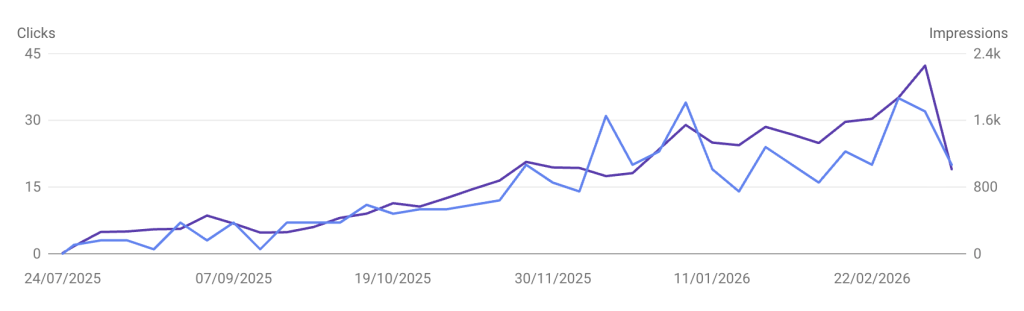
    In July 2025, the site had zero impressions. Zero clicks. Google hadn’t acknowledged it existed. That’s not unusual for a new site — but it’s worth stating clearly: this wasn’t a site with existing authority that I pivoted to AI content. It was built from the ground up, in a niche, targeting the US market.

    Over the following months, I published roughly 30 pages using AI. Not dumped in bulk — built out gradually, with each page targeting a specific topic cluster and search intent. The content was generated using AI tools, then reviewed, lightly edited for accuracy, and published.

    The Strategy: GSC as a Feedback Loop

    The part that made this work — and this is the part I want to emphasise — wasn’t just publishing AI content and hoping for the best. The real engine was using Google Search Console as a continuous feedback loop.

    Every few weeks, I’d log into GSC and look at:

    • Which queries were triggering impressions — often different from what I’d originally targeted
    • Where pages were ranking — positions 8–20 are the sweet spot for optimisation effort
    • Which pages had impressions but low CTR — a signal that the title tag or meta description needed work

    I’d then go back into those pages, update the content to better match the actual search queries driving impressions, tighten the on-page signals, and republish. Rinse and repeat.

    This is essentially AI SEO in practice — using data to inform AI-assisted content decisions rather than guessing at what to write.

    Where It Is Now: 500 Impressions a Day

    As of today, the site is generating approximately 500 impressions per day and around 10 clicks per day. That’s a growth curve from absolute zero, with no link building spend and no paid traffic.

    Is 10 clicks a day going to make anyone rich? No. But consider what it represents:

    • A 2% average CTR, which is in line with organic benchmarks for sites without strong brand recognition
    • A growing impression curve that suggests Google is indexing and serving more pages over time
    • A foundation of topical authority being established without a dollar spent on link acquisition

    The trajectory matters more than the current numbers. A site at 500 impressions/day after 8 months, built on AI content alone, is on a compounding curve — not a flat line.

    What’s Driving the Growth

    A few things I’ve observed that appear to be moving the needle:

    Iterative content updates beat set-and-forget

    Pages that I’ve gone back and updated based on GSC data consistently outperform pages I published and left alone. This confirms something I’ve believed for a while: Google rewards freshness and relevance signals, and the AI-generated first draft is just that — a draft. The real SEO work happens in the iteration.

    Niche focus compounds faster than broad content

    Because this site targets a specific niche rather than trying to cover everything, the 30 pages are tightly interconnected. Internal linking between related posts reinforces topical authority signals. Google appears to be treating the site as a relevant resource for a defined subject area — which is exactly what you want.

    No link building — yet

    This is perhaps the most interesting finding. The site has grown entirely on on-page signals and content quality. Zero backlinks acquired through outreach or paid placements. That’s unusual, and it does suggest that for niche topics with modest competition, AI content optimised for search intent can gain traction on its own.

    That said — I’m now at the point where link building starts to make sense. The site has enough topical authority to make guest posting worthwhile, and I expect that adding even a modest number of quality backlinks will accelerate the impression and click curves significantly. That’s the next phase of the experiment.

    What I’d Do Differently

    A few things I’d change if I were starting today:

    • Start GSC monitoring from day one. I waited a couple of months before reviewing data seriously. Earlier iteration would have accelerated the growth curve.
    • Build the internal linking structure upfront. I added internal links retroactively, which is more time-consuming. Planning the content cluster before publishing makes the site architecture stronger from the start.
    • Add schema markup earlier. Structured data (FAQ schema, Article schema) helps Google understand page content faster. I added this late in the process.

    The Bigger Point

    The debate about whether AI content can rank has been running for years. Based on this experiment, my answer is: yes, it can — but only if you treat AI as the beginning of the process, not the end.

    The sites that will fail with AI content are the ones bulk-publishing and walking away. The ones that will win are treating AI as a scalable first draft engine, and then using data — GSC, user behaviour, ranking signals — to continuously improve what’s already published.

    That’s the process I use with clients and this case study is proof it works — even on a site where I’ve deliberately kept the effort and spend low to test the floor.

    If you’re thinking about building something similar, or want to apply this approach to an existing site, get in touch. The playbook is replicable.


    Frequently Asked Questions

    Does AI-generated content rank on Google?

    Yes — based on this experiment and broader industry evidence, AI content can rank when it’s optimised for search intent, structured correctly, and updated iteratively based on performance data. Google’s stated position is that it evaluates content quality regardless of how it was produced.

    How long does it take for AI content to rank?

    In this case study, meaningful impressions started appearing around 2–3 months after publishing, with consistent growth from month 4 onwards. New sites typically take 3–6 months to gain traction regardless of content type, as Google builds trust in the domain.

    Do you need backlinks for AI content to rank?

    Not necessarily in the early stages — this site reached 500 impressions/day with zero link building. However, backlinks become increasingly important for competitive queries and moving from page 2–3 rankings into page 1. Guest posting and digital PR are the logical next step once a content foundation is established.

    What AI tools were used to create the content?

    The content was generated using large language model tools, informed by keyword research and search intent analysis. The specific toolset matters less than the process: research intent first, generate content to match, review for accuracy, optimise on-page signals, monitor and iterate.

  • AI SEO vs Traditional SEO: What’s Actually Changed

    AI SEO and traditional SEO are not two different disciplines — they’re the same discipline at different levels of scale and automation. But the differences matter, especially if you’re deciding how to structure your SEO operation or where to invest.

    What Hasn’t Changed

    The fundamentals of SEO haven’t changed. Google still rewards pages that are technically sound, genuinely useful, well-structured, and authoritative. Keyword research, on-page optimisation, link building, and content quality are still the core levers. Any SEO approach — AI-powered or not — that ignores these fundamentals doesn’t work.

    What AI SEO Does Differently

    The difference is in how those fundamentals are executed. Traditional SEO relies on human effort for every task. AI SEO automates the repetitive, data-driven tasks — keyword clustering, technical audits, brief generation, rank reporting — so humans can focus on the strategic and creative work that actually requires judgement.

    The practical result: an AI SEO operation can produce the same output as a larger traditional SEO team at lower cost and higher speed. A keyword research process that takes a traditional SEO analyst two days might take an AI SEO agent twenty minutes.

    Speed and Scale

    This is where the gap is most visible. Traditional SEO is bounded by hours — the hours your team or agency can put in each week. AI SEO removes that ceiling for the tasks it handles. Weekly automated technical audits catch issues that would be missed in a quarterly manual review. Automated content brief generation means your writers can produce three times the output with the same team.

    Quality and Judgement

    Traditional SEO has an edge in nuanced quality judgement. An experienced SEO knows when a page feels authoritative, when an angle will resonate with a specific audience, when a link opportunity is genuinely valuable versus superficially attractive. AI systems can approximate this judgement — and are getting better quickly — but they’re not there yet.

    The best AI SEO operations don’t try to automate judgement. They automate data gathering, processing, and repetitive execution — then feed the output to humans who apply the judgement. That combination is more powerful than either approach alone.

    Cost

    Traditional SEO at scale is expensive. Agencies, in-house teams, freelancers — the cost of human time adds up quickly. AI SEO can dramatically reduce the per-task cost for automatable work. The upfront investment is in building and tuning the systems; the ongoing cost is much lower than maintaining a large manual operation.

    What’s Actually Changed in 2025-2026

    • AI Overviews and answer engines now require a separate optimisation strategy (AEO) on top of traditional SEO
    • AI tools have made keyword research, brief writing and reporting significantly faster for teams that use them
    • Google’s ability to assess content quality has improved — thin AI-generated content without human editing performs worse, not better
    • The gap between SEO teams that use automation and those that don’t is widening faster than ever

    Which Approach Is Right for You?

    If you’re a small business doing SEO in-house with limited resources, AI SEO tools can significantly increase what you’re able to produce. If you’re a growing business with a content team, AI SEO automation can help you scale output without scaling headcount. If you’re an enterprise, AI SEO systems can standardise and accelerate operations across large content teams.

    In every case, the strategic layer still needs human expertise. If you’re looking to build AI SEO systems rather than just use AI tools, working with an AI SEO consultant is the fastest path to getting it right.

    For the practical side, read: How to Automate SEO With AI — a step-by-step framework for replacing manual SEO tasks with automated systems.

  • SEO AI Agents: What They Are and How to Build One

    SEO AI agents are automated systems that handle specific SEO tasks without manual intervention. Think of them as specialised workers you build once and deploy permanently — a keyword research agent that runs on demand, a technical audit agent that checks your site weekly, a content brief agent that produces structured briefs on command.

    They’re one of the most practical applications of AI for SEO teams right now, and they’re more accessible to build than most people assume.

    What Makes Something an “Agent”?

    An agent is different from a simple AI prompt. A prompt takes input and returns output once. An agent can take a goal, break it into steps, use tools (APIs, databases, web search), and iterate until the task is done. An SEO keyword research agent, for example, might: receive a seed topic, pull keyword data from an API, cluster keywords by intent using an LLM, filter by difficulty threshold, and output a formatted spreadsheet — all without a human involved after the initial trigger.

    Types of SEO AI Agents

    • Keyword research agents — cluster and prioritise keywords by intent and opportunity
    • Content brief agents — analyse SERPs and generate structured content briefs
    • Technical audit agents — crawl your site on a schedule and flag issues automatically
    • Internal linking agents — identify and suggest internal link opportunities across your content
    • Rank monitoring agents — track rankings and surface movements that need attention
    • Reporting agents — pull data from GSC, GA4 and rank trackers and produce weekly summaries

    How to Build a Basic SEO Agent

    Most SEO agents are built using a combination of Python (for logic and data processing), an LLM API like OpenAI (for analysis and generation), and a data source (Ahrefs API, SEMrush API, Screaming Frog API, or GSC API). The workflow is typically orchestrated using a tool like n8n, which handles scheduling, triggers, and connecting different tools together.

    A simple keyword clustering agent might look like this: a Python script pulls keyword data from SEMrush, sends it to the OpenAI API with a prompt to cluster by intent and suggest content format, and writes the output to a Google Sheet. Total build time for a developer: half a day.

    Do You Need to Code?

    You don’t need to be a developer to use AI SEO agents — but you do need either some technical ability or access to someone who has it. Tools like n8n are relatively low-code, and there are growing libraries of pre-built SEO agent templates. But for custom systems tailored to your specific workflow, Python and API knowledge helps.

    If building agents yourself isn’t feasible, working with an AI SEO consultant who builds and deploys these systems is a faster path to getting the benefits without the learning curve.

    Where Agents Deliver the Most Value

    The highest-value SEO agents are the ones that replace tasks your team currently does manually on a regular schedule. Weekly technical audits, monthly keyword refreshes, quarterly content gap analysis — these are the processes that cost the most time over a year and benefit most from automation. Start there.

    New to AI SEO entirely? Start with: What Is AI SEO? The Complete Guide for 2026.

  • The Best AI SEO Tools in 2026 (Ranked and Reviewed)

    The AI SEO tools market has grown quickly. There are now dozens of tools claiming to use AI to improve your SEO — some genuinely useful, some overhyped. This guide cuts through the noise and covers the tools actually worth using in 2026, organised by what they do best.

    1. Surfer SEO — Best for AI-Assisted On-Page Optimisation

    Surfer analyses the top-ranking pages for your target keyword and gives you a content score based on word count, headings, keyword density, and structure. It’s not a magic ranking tool, but it’s one of the more reliable ways to check whether your on-page optimisation is in the right range for a given keyword. Best used as a guide, not a gospel.

    2. Screaming Frog + API — Best for Automated Technical Audits

    Screaming Frog is already the industry standard for technical SEO crawling. With its API, you can schedule automated crawls, push results to Google Sheets or Slack, and build technical audit pipelines that run without manual intervention. Combined with Python scripts, it becomes one of the most powerful automation tools in an AI SEO stack.

    3. SEMrush / Ahrefs — Best for Keyword Data at Scale

    Both remain the go-to sources for keyword volume, difficulty, and competitive data. For AI SEO specifically, their APIs are what matter — once you can programmatically pull keyword data, you can feed it into AI-powered clustering and intent analysis agents. Ahrefs has a slight edge for backlink data; SEMrush for keyword tracking and site audit features.

    4. OpenAI API — Best for Building Custom SEO Agents

    The OpenAI API is the backbone of most serious AI SEO automation. Used directly (not through ChatGPT), it lets you build custom agents — keyword clustering tools, content brief generators, metadata optimisers — that are trained to your specific workflow and brand voice. The learning curve is steeper, but the flexibility is unmatched.

    5. n8n — Best for Workflow Orchestration

    n8n is an open-source workflow automation tool that connects your SEO tools together. It’s what allows a weekly Screaming Frog crawl to trigger an automatic Slack alert, or a new keyword list from SEMrush to automatically kick off a brief generation process. Less flashy than some tools, but one of the most practically valuable pieces of an AI SEO stack.

    6. Perplexity & ChatGPT — Best for Research Acceleration

    Both are useful for accelerating the research phase of SEO — competitor analysis, topic exploration, identifying the key questions your audience is asking. They’re not reliable for data (always verify numbers from primary sources), but for qualitative research and drafting, they save significant time.

    What to Avoid

    Be cautious of tools that promise to “write SEO content” at scale with no human review. AI-generated content that isn’t edited for accuracy, tone, and originality is a liability — both for rankings and for your brand reputation. AI should accelerate your SEO workflow, not bypass the quality checks that make it work.

    The Bottom Line

    The best AI SEO stack isn’t the most expensive one — it’s the one that fits your workflow, solves your specific bottlenecks, and has someone who knows how to use it. If you’re looking to build a proper AI SEO system rather than just adding tools, that’s where a specialist can help.

    Want to understand how these tools connect into a system? Read: SEO AI Agents — What They Are and How to Build One.

  • How to Automate SEO With AI: A Practical Framework

    SEO automation with AI isn’t about replacing your SEO strategy — it’s about removing the manual bottlenecks that slow execution down. This guide walks through a practical framework for automating the parts of SEO that are repetitive, time-consuming, and don’t require human creativity.

    Step 1: Identify What’s Worth Automating

    Not everything in SEO should be automated. Start by listing every SEO task your team does regularly and asking two questions: is this task repetitive, and does it require creative judgement? Tasks that are data-driven — keyword clustering, rank tracking, technical crawls, GSC reporting — are good automation candidates. Tasks that require brand judgement or creative thinking generally still need humans.

    Step 2: Automate Keyword Research

    Keyword research is one of the highest-leverage things you can automate. A well-built agent can pull data from multiple sources, cluster keywords by intent, estimate difficulty and opportunity, and output a prioritised list — in minutes, not days. The OpenAI API combined with keyword data from Ahrefs or SEMrush lets you build agents that annotate keywords with intent, volume context, and recommended content formats.

    Step 3: Automate Technical Audits

    Running a technical audit manually typically happens quarterly at best. With the Screaming Frog API and a scheduling tool like n8n, you can set up weekly automated crawls that flag new issues — broken links, indexation problems, page speed regressions — before they impact rankings. Push the output to Slack or a Google Sheet automatically. Your team sees issues the moment they appear, not weeks later.

    Step 4: Automate Content Briefs

    Content briefs are one of the biggest bottlenecks in most content operations. A brief that takes an analyst an hour to produce can be generated in seconds with the right system — pulling competitor analysis, SERP structure, recommended headings, and FAQ suggestions automatically. The brief still needs human review before going to a writer, but the time savings are significant.

    Step 5: Automate Reporting

    GSC reports, rank tracking updates, and traffic summaries are prime automation candidates. Python scripts can pull from the Google Search Console API, combine it with rank tracker data, and produce a formatted weekly summary — without anyone touching a spreadsheet.

    The Right Stack

    The core stack I use with clients: Python for scripting and data processing, n8n for workflow orchestration, the OpenAI API for AI-powered analysis, and the Screaming Frog API for automated crawls. Most of this can be set up by a developer or an AI SEO consultant in a matter of days.

    Where to Start

    Start with the highest-pain task on your team’s list — usually keyword research or technical auditing. Build one automated process, run it for a month, measure the time saved. Then expand. Automation compounds — the more processes you systematise, the more leverage you build.

    If you’re exploring the tools to make this happen, see: The Best AI SEO Tools in 2026 — ranked and reviewed for practical use.

  • What Is AI SEO? The Complete Guide for 2026

    AI SEO is the use of artificial intelligence and automation to improve and scale search engine optimisation. Instead of doing every SEO task manually — keyword research, content briefs, technical audits, reporting — AI SEO uses tools, agents, and automated pipelines to handle those tasks faster and at greater scale.

    It’s one of the fastest-moving areas in digital marketing right now. And if you’re running a business that relies on organic search, understanding AI SEO is no longer optional.

    AI SEO vs Traditional SEO: What’s the Difference?

    Traditional SEO relies on people doing the work. Someone researches keywords, someone writes a brief, someone audits the site, someone checks rankings. Every task takes time, and the output is limited by how many hours your team has.

    AI SEO changes that equation. The strategic thinking is still human — you still need someone who understands search, business goals, and what it takes to compete in your market. But the execution can be partially or fully automated. A keyword research agent can run in minutes. A technical audit pipeline can check your site every week without anyone lifting a finger. A content brief generator can produce a structured brief in seconds.

    The result: the same SEO output that might take a team days now takes hours — or runs on a schedule without any manual input at all.

    What Does AI SEO Actually Look Like?

    AI SEO isn’t one thing — it’s a set of capabilities applied to different parts of the SEO process. Here’s what it looks like in practice:

    • Keyword research agents — tools that cluster keywords, identify intent, and map opportunities automatically
    • Automated content briefs — systems that analyse the top-ranking pages and generate structured briefs for writers
    • Technical audit pipelines — scheduled crawls that flag issues weekly and log them to a dashboard
    • Rank tracking and reporting — automated reports that pull from GSC and rank trackers on a schedule
    • Content gap analysis — AI tools that compare your content to competitors and surface what’s missing

    Who Is AI SEO For?

    AI SEO is most valuable for businesses and marketing teams that need to scale their SEO output without proportionally scaling their headcount. If you’re spending significant time on repetitive SEO tasks — or if you’re falling behind on SEO because the manual work is too time-consuming — AI SEO is worth exploring.

    It’s also particularly relevant if you’re operating in a competitive niche where speed matters. The businesses that can research, brief, publish, and optimise faster than competitors will compound an advantage over time.

    Do You Need an AI SEO Consultant?

    You don’t need a consultant to start using AI SEO tools. But if you want to build reliable, scalable systems — rather than just adding AI tools on top of your existing workflow — working with an AI SEO consultant can shortcut the process significantly.

    A consultant who specialises in AI SEO will know which tools are worth using, how to connect them into a coherent system, and how to make sure the outputs are actually moving your rankings. They’ll also know what AI can’t do — and where human judgement is still essential.

    The Bottom Line

    AI SEO is not a replacement for good SEO strategy. It’s a force multiplier. The businesses getting the most from it aren’t using AI to cut corners — they’re using it to do more of the right things, faster, at lower cost. That’s the opportunity.

    Ready to go deeper? Read: How to Automate SEO With AI — a practical step-by-step framework for building your first automated SEO process.